
Web scraping looks deceptively simple when you test a handful of requests against friendly targets. Data flows cleanly, no blocking systems trigger, and confidence builds fast. Then production reality hits with anti-bot detection, JavaScript-heavy pages, and scale demands that shatter your initial setup. The gap between a working script and a reliable production pipeline is wider than most teams ever anticipate before deployment.
This article goes beyond listing popular tools that look good in demos. We focus on APIs that actually survive real workloads, handling blocking, rendering, and keeping data flowing when conditions get rough. The breakdown covers what makes these solutions different and where each one makes practical sense for production use cases.
Best Web Scraping APIs That Actually Hold Up in Production
Not all scraping APIs solve the same problems, and that becomes obvious the moment you move beyond small tests. Some tools focus on infrastructure, some simplify workflows, and others handle data extraction end to end. The differences only show up when websites start pushing back.
The list below reflects that reality. Each solution takes a different approach to handling blocking, rendering, and scale. We start with the one that removes the most operational friction when scraping becomes part of a production system.
1. HasData
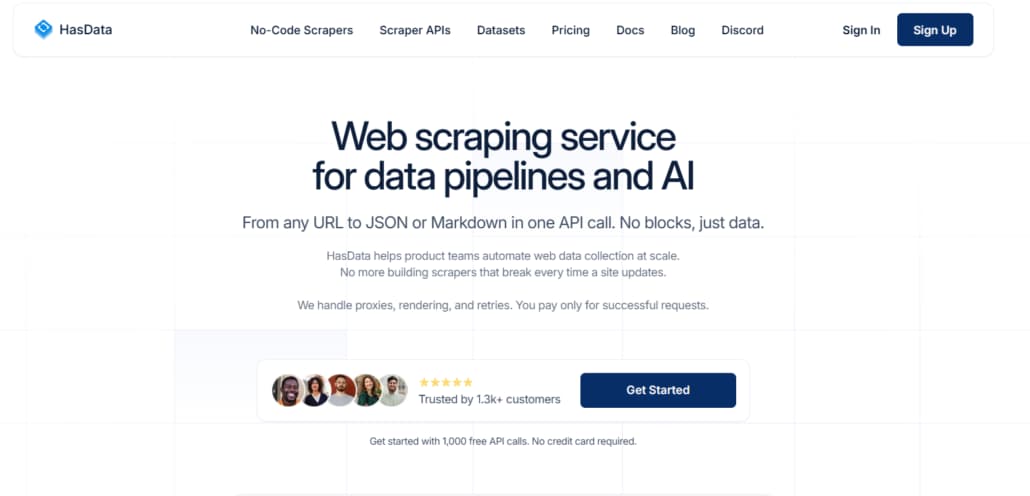
HasData Web Scraping operates as a unified API that collapses the entire scraping stack into a single endpoint. Proxy rotation, browser rendering, and anti-bot countermeasures all run inside the platform without exposing infrastructure complexity to users. This matters when scraping shifts from experimentation to production dependency where downtime has real costs. A fragmented setup with separate proxy services and rendering engines creates failure modes at every boundary between components.
The platform handles blocking systems, JavaScript execution, and data extraction internally. Teams call the API, configure what they need, and receive clean structured output without managing proxy pools or debugging rendering failures. HasData targets environments where scraping must work consistently without dedicated maintenance cycles draining engineering capacity.
How It Handles Production Complexity
Running proxies, rendering engines, and parsers as separate services multiplies operational headaches that surface at the worst possible moments. Each service needs monitoring, updates, and troubleshooting when target websites change their defenses. A unified platform absorbs this complexity rather than delegating it to already stretched engineering teams who have actual product work to deliver.
The platform covers the full scraping workflow through coordinated infrastructure:
- Single API request for large-scale scraping;
- Automatic proxy rotation across IP types;
- Anti-bot and CAPTCHA bypass;
- JavaScript rendering for dynamic pages;
- AI-based data extraction without selectors;
- Batch scraping and page interactions.
This approach reduces the maintenance burden that typically consumes engineering resources after initial deployment.
When It Makes Sense to Use
HasData fits teams running continuous high-volume scraping pipelines against aggressively defended targets. Companies that want reliable data extraction without building and maintaining scraping infrastructure will find this unified model practical for long-term production operations.
2. Zenscrape
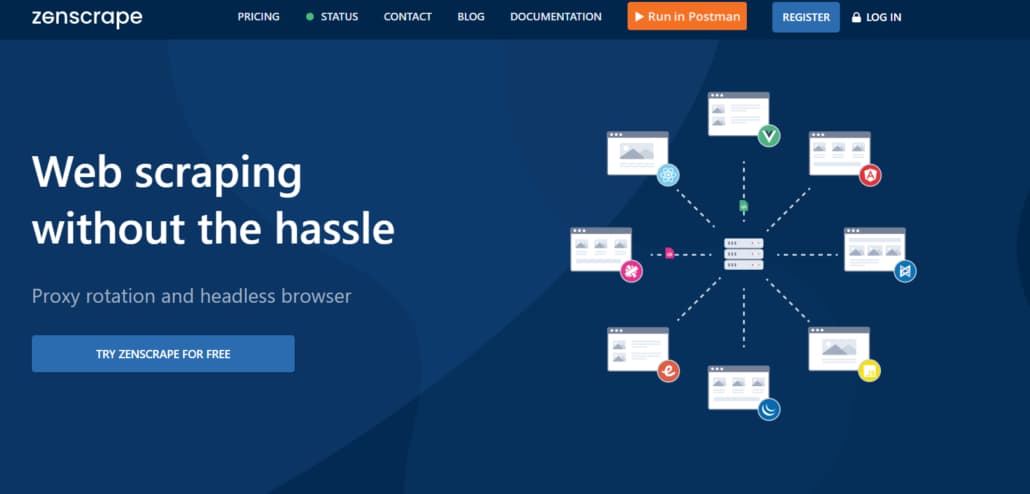
Zenscrape offers a straightforward scraping API that prioritizes fast deployment and minimal friction during integration. The platform handles proxy rotation and anti-bot bypass without requiring users to configure complex infrastructure settings before getting started. Teams send requests, the API resolves rendering and blocking challenges, and structured data comes back without endless parameter tuning.
This low-friction approach suits projects where time-to-data matters more than granular control. Setup completes quickly, documentation stays manageable, and the API handles common scraping obstacles without demanding deep expertise in anti-detection strategies or proxy management techniques.
Why It Works for Fast Deployment
Scraping projects often stall during setup when teams wrestle with proxy configuration, browser rendering options, and anti-bot countermeasures before extracting a single useful data point. Simplifying this onboarding phase gets data flowing faster and reduces the likelihood that projects get abandoned before delivering value. The key capabilities supporting rapid deployment include:
- Simple API integration;
- Proxy rotation included;
- Anti-bot bypass support;
- Geolocation targeting.
Quick integration matters more than advanced configuration depth for teams that need scraping operational today rather than next month.
Best Use Cases
Zenscrape works well for smaller projects, MVPs, and teams that need scraping to function without building deep technical expertise. The low-friction setup makes it practical for use cases where development speed takes priority over infrastructure customization options.
3. ScraperAPI
ScraperAPI builds its offering on proxy-first infrastructure with a large IP pool spanning residential, datacenter, and mobile sources. The platform emphasizes request reliability through automatic retries, CAPTCHA resolution, and geographic targeting rather than advanced extraction features or AI-driven parsing capabilities. Teams configure their target parameters and the API handles delivery logistics.
This infrastructure focus trades parsing sophistication for raw reliability under sustained request loads. The proxy network absorbs blocking attempts, rotates identities when detection triggers, and maintains success rates under conditions that would overwhelm smaller proxy deployments with limited IP diversity.
Infrastructure Focus Instead of Features
Proxy quality drives scraping success more directly than any extraction algorithm or parsing technique. Bad IPs trigger blocks before parsing logic even enters the equation. A deep, well-managed proxy pool with intelligent rotation strategies keeps requests flowing when target websites aggressively defend against automated access attempts.
ScraperAPI delivers through infrastructure investment:
- Large proxy pool;
- Automatic retries;
- CAPTCHA handling;
- Request scaling.
Infrastructure strength becomes the differentiator when scraping at volumes where proxy quality determines whether data pipelines survive or collapse under sustained blocking pressure.
Where It Fits Best
ScraperAPI fits high-volume scraping projects where request reliability takes priority over advanced extraction features. Teams running large-scale data collection operations benefit from the proxy infrastructure depth that maintains success rates under heavy sustained loads.
4. ProxyCrawl
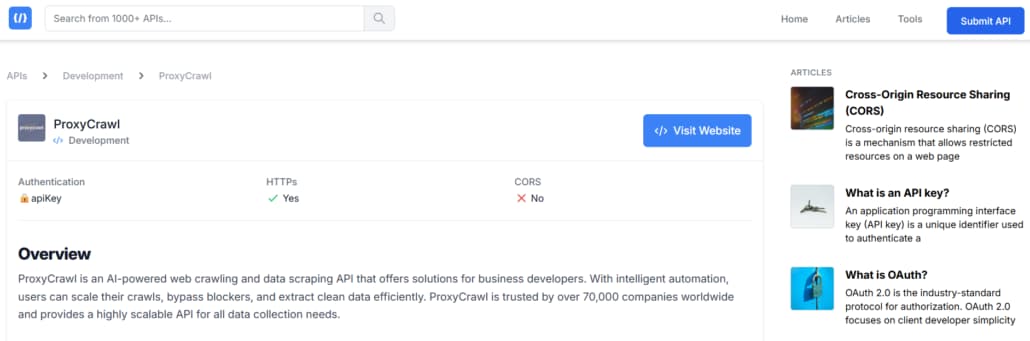
ProxyCrawl combines data extraction capabilities with SERP scraping support in a single API platform. The service handles HTML extraction, structured data endpoints, and scalable request execution without separating these functions across different tools or subscription tiers. This multi-purpose design suits teams that scrape diverse sources and want unified access rather than managing separate APIs for different target types.
The platform abstracts proxy management and blocking countermeasures while exposing endpoints optimized for different extraction scenarios. Teams choose the appropriate endpoint based on target type and receive structured output without custom parsing logic or selector maintenance responsibilities.
Multi-Purpose Data Extraction Approach
Managing separate APIs for general web scraping, SERP extraction, and structured data collection creates overhead that multiplies as project scope expands. A unified platform that handles multiple extraction scenarios through a consistent interface reduces the operational complexity of maintaining diverse data pipelines.
Key capabilities spanning multiple extraction use cases:
- SERP scraping support;
- HTML extraction;
- Structured data endpoints;
- Scalable requests.
The multi-endpoint setup keeps tooling consolidated without forcing teams to maintain relationships with multiple vendors for different data sources.
When to Use This Tool
ProxyCrawl fits data-heavy projects that scrape diverse sources and want extraction infrastructure consolidated under a single API. Teams running both general web scraping and SERP data collection benefit from the unified approach to data extraction across different target categories.
5. FetchFox

FetchFox takes an AI-first approach to web scraping by combining Chrome-based browsing with intelligent extraction that reduces dependence on brittle selectors. The platform runs actual browser instances that render JavaScript, handle interactive elements, and extract content using AI models trained to identify relevant data patterns without manual configuration.
This approach shifts extraction logic from code that breaks when websites update toward AI models that adapt to layout changes more gracefully. Teams define what data they need, and the AI handles identification and extraction without requiring constant selector maintenance as target pages evolve their markup structures.
AI-Based Extraction Workflow
Selector-based extraction fails predictably when websites update layouts, rename CSS classes, or restructure content hierarchies. Maintaining extraction rules across dozens or hundreds of targets consumes engineering resources that most teams can’t sustain. AI-driven extraction reduces this maintenance burden by understanding page content semantically rather than depending on specific DOM paths.
The platform delivers AI-assisted extraction through:
- Chrome-based scraping;
- AI-assisted extraction;
- Visual interaction support;
- Lightweight setup.
AI extraction adapts to layout changes that would break traditional selector-based approaches, improving long-term stability.
Ideal Scenarios
FetchFox fits teams that need data extraction from frequently changing websites where selector maintenance would create unsustainable overhead. AI-based extraction handles layout volatility more gracefully than brittle parsing scripts that require constant updates.
6. Browserless
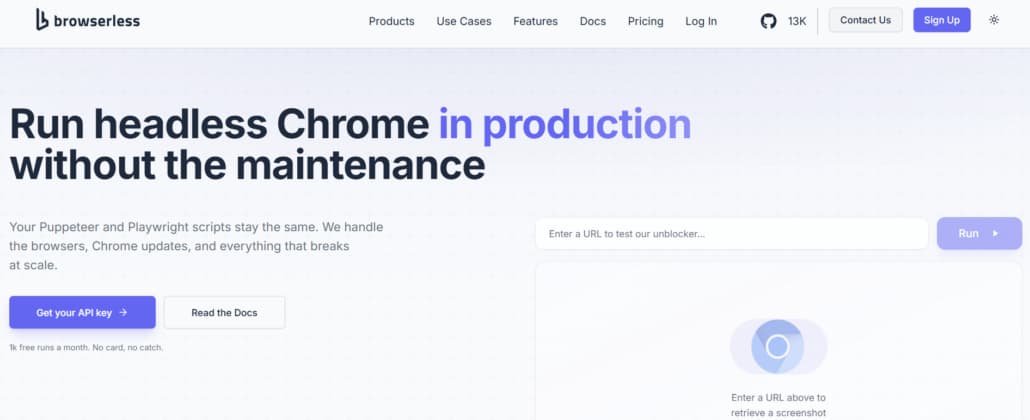
Browserless provides headless browser infrastructure as a managed service rather than a traditional scraping API with predefined extraction logic. Teams deploy Puppeteer scripts against Browserless infrastructure, gaining scalable browser execution without managing their own browser pools, session handling, or resource allocation. This approach suits projects that need full browser execution control combined with managed infrastructure.
The platform handles the operational complexity of running browsers at scale: session management, resource limits, concurrency handling, and infrastructure maintenance. Teams bring their own automation scripts and Browserless provides the execution environment that scales without requiring browser infrastructure expertise.
Full Browser Execution at Scale
Running headless browsers at production scale introduces infrastructure challenges that differ fundamentally from API-based scraping. Browser instances consume significant memory and CPU resources. Session management becomes complex as concurrency increases. Scaling requires infrastructure that provisions and decommissions browser resources dynamically based on current load conditions.
Browserless provides browser infrastructure through:
- Headless browser infrastructure;
- Puppeteer support;
- Scalable sessions;
- JS-heavy page handling.
Managed browser execution eliminates the infrastructure burden of running browser pools for scraping projects that need full rendering capabilities.
Who This Is For
Browserless fits teams that need complete control over browser automation with Puppeteer but want managed infrastructure rather than running their own browser pools. Projects targeting JavaScript-heavy websites that require precise interaction control benefit from this execution model.
7. PhantomBuster

PhantomBuster approaches data collection through automation workflows rather than traditional request-based scraping. The platform provides pre-built automation flows that extract data from social media platforms, websites, and APIs through scheduled execution rather than on-demand requests. This automation-first model suits teams that need recurring data collection without building custom scheduling infrastructure.
The platform combines no-code setup with API access, allowing both non-technical users and developers to configure and execute extraction workflows. Pre-built automation templates cover common use cases like social media monitoring, lead generation, and competitive data tracking without requiring custom script development.
Automation-First Data Collection
Recurring data collection tasks become operational burdens when teams manually trigger scripts or build custom scheduling systems. Automation workflows that run on defined schedules remove this overhead and ensure data freshness without constant human intervention in the extraction process.
PhantomBuster delivers automation through:
- Prebuilt automation flows;
- No-code scraping;
- API + automation mix;
- Social/media scraping.
Scheduled automation handles the repetitive execution that makes manual scraping approaches unsustainable for ongoing data collection needs.
Best Fit Use Cases
PhantomBuster fits growth and automation tasks where recurring data collection from social platforms, websites, and APIs needs scheduled execution. Teams that want extraction workflows running automatically rather than managing custom cron jobs and scheduling infrastructure benefit from this approach.
Why Scraping Breaks and APIs Matter More Than Code
Scraping failures follow predictable patterns rooted in infrastructure limitations rather than coding errors. Anti-bot systems detect request patterns, analyze IP reputation, and block traffic long before extraction logic even runs. JavaScript-heavy pages serve empty responses to clients that can’t execute client-side code properly. Scale exposes every architectural weakness hidden during small tests.
APIs solve the infrastructure layer that most teams shouldn’t build or maintain on their own. Proxy rotation, browser rendering, and anti-bot strategies require constant adaptation as defensive systems evolve. The recurring failure points that plague custom scraping scripts include:
- Weak proxy handling;
- No JS rendering;
- Poor scaling logic;
- Fragile parsing;
- Missing retries.
These issues compound each other and turn isolated failures into complete pipeline outages that take days to diagnose and resolve without proper infrastructure support.
How to Choose the Right API for Your Setup
API selection should reflect real production needs rather than feature comparisons or demo performance against friendly targets. The right tool for monitoring a handful of pages monthly looks nothing like the right tool for extracting millions of product listings daily under aggressive anti-bot defenses. Testing candidates against real target websites under realistic conditions reveals differences that specification pages never capture.
Team capacity shapes viable options as much as technical requirements do. Platforms requiring extensive configuration offer more control but demand expertise that smaller teams lack. Before committing to any solution, evaluate these factors:
- Required scale;
- Target site complexity;
- Need for automation;
- Output format;
- Internal resources.
Matching tool complexity to team capability prevents the frustration of managing infrastructure that exceeds available expertise or bandwidth constraints.
Final Thoughts
Scraping reliability reveals itself only under production conditions when target websites push back against extraction attempts. Demo environments and controlled tests hide every weakness that eventually causes data pipeline failures and incomplete datasets. Infrastructure stability determines long-term success more than feature count or vendor benchmarks measured in ideal conditions.
The right API absorbs operational complexity rather than adding configuration overhead that teams must manage alongside their actual work. Choose tools based on how they perform when conditions degrade rather than how they behave during friendly evaluations. That distinction determines whether data extraction becomes sustainable infrastructure or a recurring operational problem that drains resources without delivering reliable business value.


