
The regulatory environment for crypto assets shifted dramatically in 2024 and 2025. Many founders who rushed into Lithuania or Estonia without a strategy now face a hard reset under MiCA.
Existing VASPs in the EU have until July 2026 to transition to full CASP licensing or exit the market. Bank of Lithuania now demands capital between €50,000 and €150,000, up from minimal requirements just two years ago.
The six firms on this list have handled this transition for dozens of clients. A reliable crypto licensing law firm knows which regulators have backlogs and which banks open accounts this month. That knowledge comes from submitting applications, responding to information requests, and doing it again hundreds of times.
The best crypto license law firm for a project depends on target markets, business model, and post-licensing support needs.
1. Gofaizen & Sherle
Gofaizen & Sherle is a legal consulting firm for crypto businesses that has completed over 800 licensing projects across 50+ jurisdictions. The firm also operates as a crypto license law firm serving exchanges, custodial services, tokenization platforms, and DeFi projects.
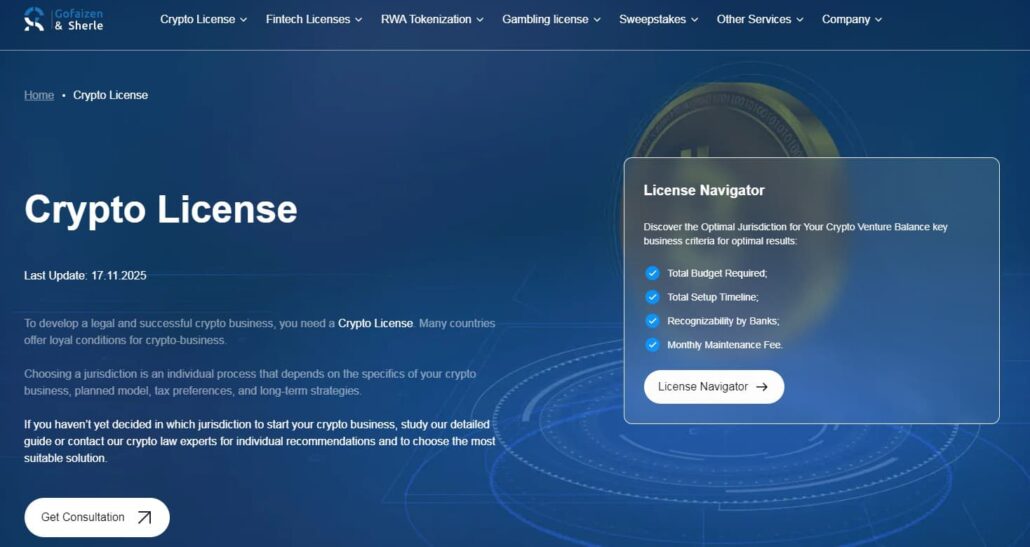
As a crypto business setup law firm, their legal consulting services start with Crypto License Navigator. That’s an in-house tool that helps choose a crypto-friendly jurisdiction for launching your business.
The firm maintains physical offices across Europe, Latin America, Asia, Canada, the USA, and Hong Kong. They rely on internal expertise, not third-party intermediaries. Their dedicated LATAM division is based in San Salvador, El Salvador.
Gofaizen & Sherle offers tiered pricing packages (Basic, Fully Operational, Complete) with transparent costs. The Complete DMCC setup in Dubai is priced at 42,000 EUR.
In Canada, they help clients register with FINTRAC as MSBs (no minimum capital required). Their clients hold four of approximately 40 DASP licenses issued in El Salvador. They also handle FINMA permits in Switzerland and MSB/MTL registration in the US.
The firm’s crypto licensing legal advisors support both emerging and established operators. Client reviews on Trustpilot mention their speed and responsiveness. One client praised their ability to handle complex regulatory situations. Public clients include WhiteBIT and Invity (SatoshiLabs).
Senior Partner Mark Gofaizen has over a decade of experience. The team has helped clients hire 200+ professionals worldwide.
What makes them different: They build regulatory structures for long-term growth across multiple jurisdictions from a single coordination point.
Best for: Crypto exchanges, custodial services, tokenization platforms, and DeFi projects needing multi-jurisdiction licensing support.
2. COREDO
COREDO is a consulting firm based in Prague, Czech Republic, founded in 2016. The firm specializes in MiCA compliance, CASP authorization, DORA requirements, and AML/KYC framework development for crypto-asset service providers.

The firm’s team includes Grigorii Lutcenko and Nikita Veremeev, who have supported dozens of international projects from company incorporation to obtaining crypto, payment, and forex licenses. In one project, COREDO helped a client with a strong IT platform but no formalized risk management processes. The team developed MiCA-compliant policy frameworks, implemented transaction monitoring, and secured authorization. The client now operates across the EU through the European passport mechanism.
COREDO performs jurisdictional screening that evaluates taxes, capital requirements, CASP authorization timelines, DORA-related costs, local AML expectations, and passporting possibilities. This crypto license law firm matches clients to the right regulatory intensity, from Estonia to Germany.
They work most actively with Estonia, Malta, Cyprus, Germany, and France. The firm notes that from 2026, the Czech Republic’s national VASP regime transforms into the CASP regime under MiCA, and AML/KYC requirements move closer to banking standards.
Key features:
- CASP authorization from company registration to licensing
- AML/KYC framework development, including Travel Rule and on-chain monitoring
- DORA compliance for IT and cybersecurity
- Reverse solicitation structuring for non-EU firms serving EU clients
What makes them different: Their practice combines deep MiCA knowledge with a focus on investment companies and institutional players. They understand the difference between “friendly” jurisdictions like Estonia and stricter ones like Germany (BaFin), and they match clients to the right regulatory intensity.
Best for: Investment companies and institutional crypto firms seeking CASP authorization in the EU with a clear path to passporting across all 27 member states.
3. Manimama
Manimama is a law firm based in Tallinn, Estonia, founded in 2019. The firm works exclusively with crypto businesses, including exchanges, wallet providers, token projects, and fintech companies. They have achieved 130+ licenses and served 300+ clients across 85 jurisdictions as of 2024, expanding to Lithuania in 2025.
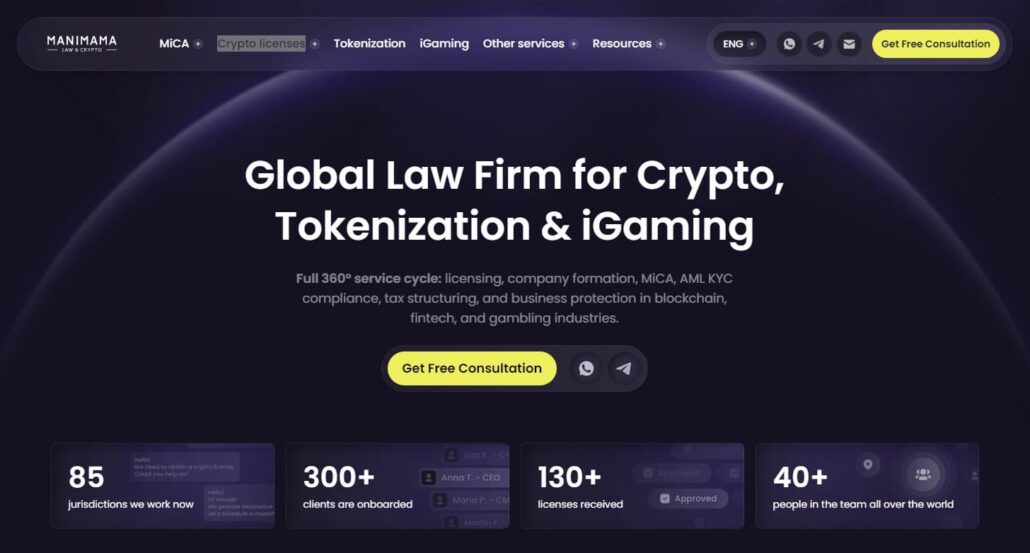
The firm’s licensing work covers jurisdiction selection, company formation, license application, and ongoing compliance support after approval. They draft AML and KYC frameworks based on each client’s business model and risk profile.
Key features:
- Crypto licensing across Lithuania, Poland, Cyprus, Malta, Canada, UAE, and Switzerland
- MiCA transition support for VASPs switching to CASP status
- Tokenization frameworks for asset-backed token issuance
- iGaming licensing for crypto gambling platforms
A notable case study involves Manimama’s KYC optimization. The firm previously used SumSub but faced slow case processing. After switching to Allpass.ai, verification time dropped from several hours to a couple of minutes. The team now uses ID document validation with OCR and MRZ recognition, liveness detection, and AML screening against 3,000+ global watchlists.
For Canada, Manimama highlights the jurisdiction under “no requirement for initial capital” and puts Canada in their “fastest registration” category. Their post-license service includes compliance reviews scheduled six months after approval, addressing FINTRAC’s tendency to circle back with follow-up questions.
What makes them different: Their “360-degree service cycle” covers licensing, compliance, payments, and ongoing operational support. They know the MiCA transition timeline well, with Estonia, Lithuania, Poland, and Cyprus among their core jurisdictions for CASP applications.
Best for: European crypto projects and international firms targeting the EU market under MiCA who want a firm that has already navigated the transition from VASP to CASP.
4. Samson Solutions
Samson Solutions offers crypto licensing services across five European jurisdictions: the Czech Republic, Lithuania, Poland, Estonia, and Slovakia. The firm was founded in 2019, and their crypto license lawyers have helped over 100 crypto and fintech enterprises, including ten major exchanges with a combined annual turnover exceeding €1 billion.
The firm publishes transparent pricing. In the Czech Republic, they offer licensing with no share capital requirement, no physical office required, and a three-week timeline starting at 1,900 EUR. In Lithuania, they handle the 125,000 EUR capital requirement, physical office setup, and placement of an AML officer on an 8-week timeline for 6,500 EUR.
A client named Denys from ChaosOTC s.r.o publicly thanked them for the MSB registration help. The testimonial reads: “Special thanks to their team for helping us with MSB registration in Canada — everything went smoothly because of their expertise”.
Key features:
- Fixed pricing with no hidden costs
- Company registration and document preparation
- Regulatory filing and compliance setup
- Compliance officer appointment (FINTRAC requirement)
- Travel Rule implementation for cross-border transfers
- Post-approval compliance support
Samson Solutions partners with Revolut, Sumsub, and Paydo. Led by Daniil Samsonov, the team combines legal, financial, and crypto expertise to deliver licensing, accounting, AML compliance, and business consulting for high-growth fintech and blockchain enterprises.
What makes them different: They publish their prices. Costs, timelines, and requirements are all laid out for each jurisdiction. The Czech Republic takes three weeks from start to finish. Few firms move that fast.
Best for: European crypto firms already operating under MiCA who want to add Canada MSB registration without switching to a new provider. Also ideal for startups that want fixed costs and quick entry into specific European countries.
5. Stalirov & Co
Stalirov & Co is an IT law firm based in Princeton, New Jersey, USA. The firm advises crypto startups on jurisdiction selection and licensing across the US, Europe, Asia, and offshore jurisdictions. Their team handles Money Services Business (MSB) registration with FinCEN and secures state Money Transmitter Licenses (MTL) across the US.
The firm operates with 14 in-house lawyers and business analysts who understand both legal requirements and the operational reality of running a crypto exchange.
Key features:
- MSB registration with FinCEN and state MTL licensing across all 50 states
- CASP licensing under MiCA in Europe
- VARA licensing for Dubai operations
- Payment Services Act licensing in Singapore
- Offshore licensing in the Cayman Islands, the British Virgin Islands, and the Bahamas
A notable case study involves Intellabridge, a publicly traded fintech company based in Colorado that operates on the Canadian Securities Exchange, OTC Markets in the US, and the Frankfurt Börse in Europe. Stalirov & Co provided a full legal and compliance review covering Europe, the USA, and Asia. The team prepared legal opinions covering Germany (integration with Solarisbank), the UAE (commercial licensing and free zone requirements), Canada (FINTRAC, CSA, and IIROC regulations), and the US (CFTC, FTC, SEC, and FinCEN requirements for integration with Prime Trust). They also developed the Privacy Policy and Terms of Use for the Kash platform.
What makes them different: They have business analysts on staff who understand payment integrations and technical infrastructure. When a regulator asks how transaction monitoring works, Stalirov & Co can explain the actual system, not just point to a policy document. Their detailed guides cover capital requirements, regulatory requirements, AML compliance, taxes, country reputation, licensing criteria, registration speed, banking access, regulatory trends, and cybersecurity audits.
Best for: US-based crypto projects or international firms targeting the American market. Also suitable for projects that need detailed regulatory breakdowns across multiple regions, especially startups aiming at the US, EU, UAE, or Singapore.
6. LEXR
LEXR is a Swiss-based legal consulting firm with over 30 legal professionals specializing in blockchain and crypto since 2016. The firm is embedded in the Swiss, EU, and US fintech ecosystem with direct ties to VCs, accelerators, and operators.
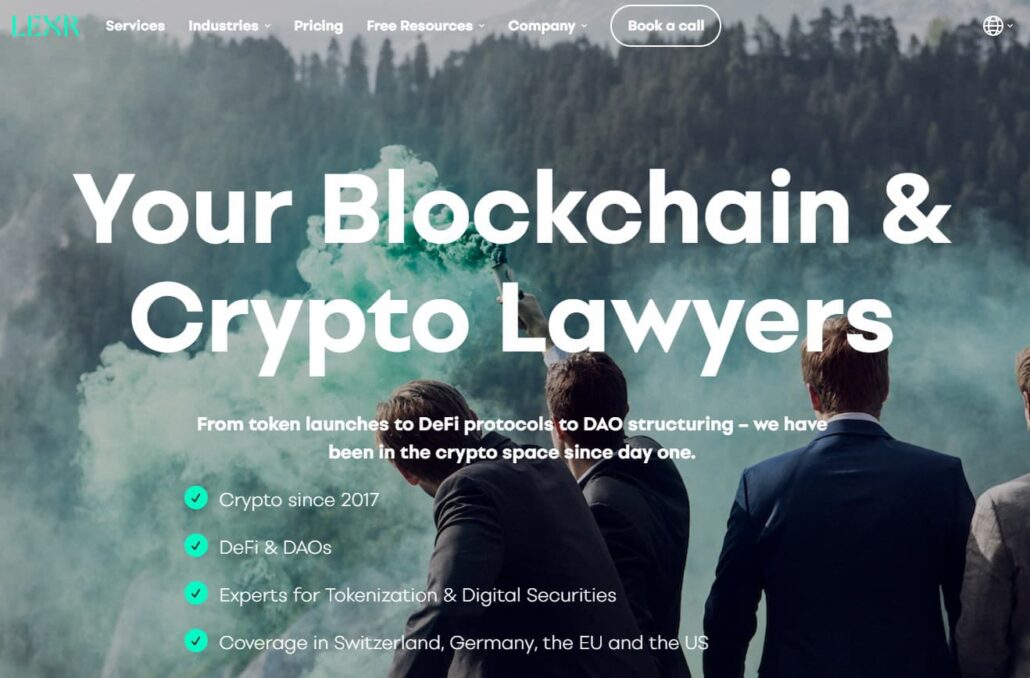
Their services include FINMA no-action letters, SRO affiliation, securities dealer licenses, DLT trading facility licenses, and VASP and CASP setup with ongoing compliance support. Dr. Stephan D. Meyer leads the practice and is recognized internationally for expertise in blockchain and digital assets.
Key features:
- FINMA no-action letters to ensure projects align with regulatory expectations
- SRO affiliation for crypto exchanges and custodians
- Securities dealer licenses for trading platforms
- DLT trading facility licenses under the Swiss DLT Act
- VASP and CASP setup with ongoing compliance
LEXR runs a two-hour workshop for founders who want to understand their options before paying for a full licensing engagement. The session covers structuring options, compliance strategies, and regulatory requirements with their legal, tax, and regulatory experts. After the workshop, clients get a summary with next steps, timelines, and fee estimates. The cost is CHF 3,800 flat.
Client testimonials on their website highlight responsiveness and deep technical understanding. One client stated: “With LEXR, we found a team of international crypto lawyers that can execute as fast as the crypto markets move”. Another noted: “LEXR provided us excellent services at very affordable costs and was always quick to react to our special wishes and change requests”.
Their MiCA white paper drafting service costs 9,500 EUR and covers comprehensive drafting of a MiCA-compliant white paper for utility tokens, memecoins, or governance tokens.
What makes them different: Most firms bill hourly while learning about the client’s business. LEXR charges CHF 3,800 for a session that tells clients whether Switzerland works for them before they pay for a full application. The firm’s people hold crypto themselves and use DeFi protocols.
Best for: Projects targeting Switzerland as a base with broader European ambitions. Also suitable for founders who want to validate their jurisdiction choice before committing to a full licensing engagement.
Final Thoughts
The firms listed here all get licenses approved. That is the baseline requirement. The difference shows up in what happens after. A crypto business legal setup firm that disappears after approval leaves clients exposed to audit risks.
Some hand over a PDF and disappear. Others install compliance systems, train the team, and stick around for the first audit. The best legal crypto consulting firms build client relationships around long-term operational support rather than one-off transactions.
A crypto license in 2026 starts a relationship that keeps going. Regulators expect regular reporting. They want to see policy updates. They conduct compliance audits. The license is the beginning, not the finish line. Working with experienced lawyers for obtaining a crypto license means getting more than paperwork.
The question is not just who can get a license. It is who can keep a license when the rules change next year. A specialized legal firm for obtaining a crypto license, like Gofaizen & Sherle, with over 800 licenses across 50+ jurisdictions and the Crypto License Navigator tool, has demonstrated the ability to do both. Their track record of helping clients hire 200+ compliance professionals and securing rare DASP licenses in El Salvador shows what is possible when a legal consulting firm for crypto business thinks beyond the application.
Choose the firm that matches the actual needs. A multi-jurisdiction strategy requires a different partner than a single license in one country. A US-focused project needs someone who knows the state-by-state MTL system. A European expansion requires MiCA expertise. Match the firm to the plan, and the process becomes something that can be managed rather than something that manages the business.


